
A bilateral US-UK airplane wastewater monitoring pilot demonstrates the feasibility of an international wastewater surveillance network
Publication: Wade et al., Scientific Reports (2026)
Overview
This study evaluated the feasibility of a bilateral airplane wastewater surveillance network for monitoring infectious disease threats across international borders. Over approximately six months of coordinated US–UK surveillance, researchers collected 424 wastewater samples from transatlantic flights and tested them for seven respiratory and enteric pathogens, with SARS-CoV-2-positive samples further evaluated by genomic sequencing. Ceres Nanotrap® Microbiome Particles were used to concentrate airplane wastewater during the primary workflows in both countries, demonstrating their application within an operational, international pathogen surveillance program.
Key Findings
High rates of pathogen detection in airplane wastewater
Of 424 samples, 74.8% were positive for at least one respiratory pathogen and 71.5% were positive for at least one enteric pathogen.
Targets included SARS-CoV-2, influenza A and B, RSV, norovirus GI/GII, and adenovirus F40/41.
Among UK-origin flights, SARS-CoV-2 was detected in 72.4% and norovirus GII in 79.9% of samples, demonstrating the strong pathogen signal available from aircraft wastewater.
Nanotrap particles supported multi-pathogen surveillance
UK-origin samples were concentrated using Nanotrap Microbiome Particles in an automated workflow with the KingFisher™ Apex, followed by MagMAX nucleic acid extraction and dPCR.
During the first phase of US-origin flight testing, Nanotrap particles were also used in a 10 mL manual concentration workflow followed by MagMAX extraction and RT-qPCR.
The workflows supported detection of both respiratory and enteric viruses, demonstrating compatibility with broad, multi-target surveillance rather than a single-pathogen application.
Low-level signals provided valuable early-warning information
Of 77 SARS-CoV-2 samples that were positive using the standard dPCR threshold but would have been classified as negative using a more stringent three-partition threshold, 80.5% produced ≥25% genome coverage at ≥10× depth.
No SARS-CoV-2 sequences were recovered from samples classified as negative under both thresholds.
These results demonstrate that low-level wastewater signals can represent genuine positives and may be important for early detection.
Genomic sequencing tracked emerging SARS-CoV-2 variants
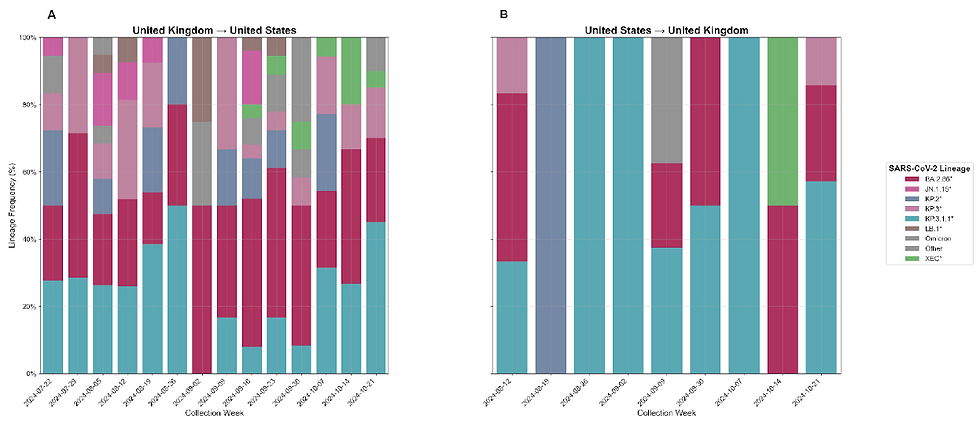
Wastewater sequencing captured multiple circulating SARS-CoV-2 lineages in travelers moving between the US and UK.
Notably, the emerging XEC recombinant variant was detected in UK-origin flight wastewater four weeks earlier than in US-origin flight wastewater.
The lineage data shown on page 13 illustrate how aircraft wastewater can capture the geographic movement and emergence of viral variants.
Implications for Nanotrap Technology
This study demonstrates the use of Nanotrap Microbiome Particles in a real-world, international aviation wastewater surveillance program involving public health agencies, airports, airlines, automated sample processing, molecular detection, and genomic sequencing. Nanotrap concentration supported multi-pathogen detection from the human-waste-rich aircraft matrix and was compatible with both manual and KingFisher automated workflows. The study therefore provides an important example of how Nanotrap technology can be incorporated into scalable traveler-based and point-of-entry surveillance systems designed for emerging pathogen detection and pandemic preparedness.
Conclusion
The authors conclude that bilateral airplane wastewater surveillance is operationally and analytically feasible and could form the basis of a broader international early-warning network. Across 424 transatlantic flight samples, the program detected diverse respiratory and enteric pathogens and generated SARS-CoV-2 genomic data capable of tracking emerging variants. The successful deployment of Nanotrap Microbiome Particles as a wastewater concentration method supports their utility in aviation surveillance workflows.
SKU 44XXX


Comments